

IPL for dark skin is the one hair-removal topic where getting the facts wrong does not just waste your money. It can burn you. So this guide is going to be straighter with you than most product pages are prepared to be, including about when the honest answer is “not this, not for you.”
The short version: IPL for dark skin can work safely on some deeper tones and is genuinely risky on the deepest. The line between those two situations is not a marketing detail. It is the whole conversation.
Let’s walk through exactly where that line sits, why skin tone changes everything, and what the safer options are if IPL is not right for you.
Key Takeaways
- IPL for dark skin is safe within limits: generally suitable up to around Fitzpatrick type V, and not recommended for type VI, the deepest skin tones.
- The risk on very dark skin is real: burns, blistering and hyperpigmentation, because the skin’s own melanin absorbs the light meant for the hair.
- Reputable home IPL devices have a skin-tone sensor that refuses to fire on tones too dark to treat safely. That is a safety feature working as intended, not a fault.
- For the deepest skin tones, the Nd:YAG laser performed by a professional is the recognised gold standard, not IPL.
- Whatever your tone, a patch test and conservative settings are non-negotiable.
Is IPL Safe for Dark Skin? The Honest Answer
IPL for dark skin depends on how deep your skin tone is, and that dependency is not something to gloss over. For light-to-medium and many olive and light-brown tones, IPL for dark skin can work well with sensible precautions. For the deepest tones, IPL is widely advised against for hair removal because the risk of burns and lasting pigment changes climbs sharply.
Reviews of IPL for dark skin, and light-based hair removal more broadly, reach a fairly consistent conclusion. IPL can be used with care in the mid-range of the scale, but for Fitzpatrick types V and VI the safer, better-evidenced choice is a specialist laser. That is not gatekeeping. It is physics, and it is your skin.
Why Skin Tone Changes Everything
IPL works by sending light into the skin, where the pigment in your hair absorbs it, heats up, and damages the follicle. The technical name is selective photothermolysis, which is a grand way of saying “the light is supposed to find the hair, not the skin.”
The problem with IPL for dark skin is that melanin is melanin. The pigment in dark hair and the pigment in dark skin both absorb the same light. On light skin with dark hair, the contrast is high and the light knows exactly where to go. As skin tone deepens, the skin itself starts competing for that energy, and the light can no longer tell hair from skin as cleanly. That competition is what turns a routine session into a burn or a patch of hyperpigmentation.
This is the single most important thing to understand about IPL for dark skin. The danger is not that the technology is bad. It is that broad-spectrum light cannot reliably separate a dark hair from dark skin, and the deeper the tone, the worse that separation gets.
The Fitzpatrick Scale: Where IPL for Dark Skin Draws the Line
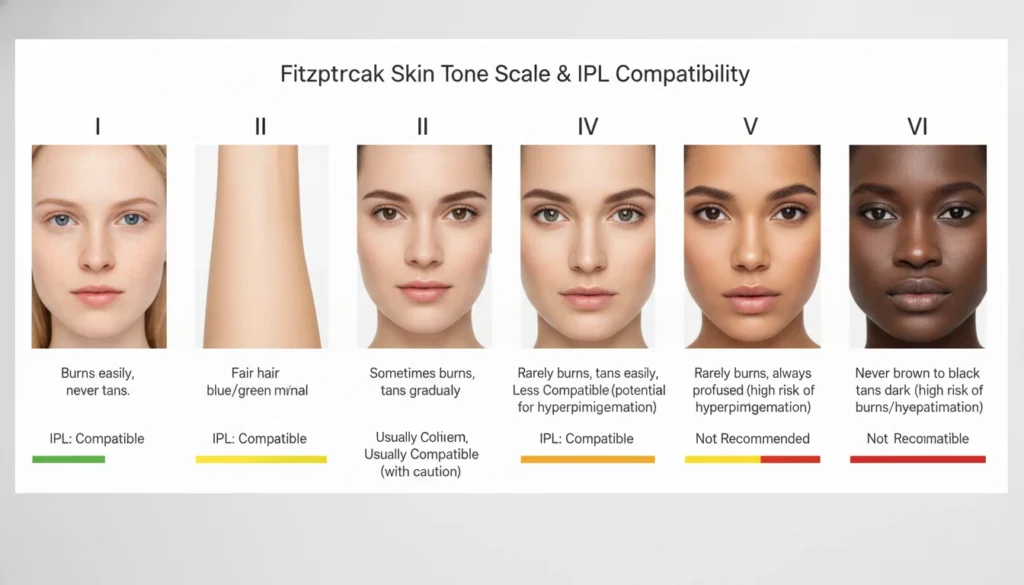
Dermatologists classify skin tone using the Fitzpatrick scale, types I through VI, from very fair to deeply pigmented. It is the standard shorthand for who can safely use what.
- Types I to III (fair to light-medium): IPL’s comfort zone. High contrast between hair and skin, lowest risk.
- Type IV (olive, light brown): IPL can work, with lower settings, careful patch testing and realistic caution.
- Type V (brown): the upper edge of what home IPL devices are typically rated for. Proceed only if the device explicitly supports your tone, and only cautiously.
- Type VI (deep brown to black): IPL is not recommended. This is where professional laser takes over.
If you are not sure where you fall, that uncertainty is itself a reason to get a professional opinion before treating at home.
6 Essential Facts About IPL for Dark Skin
1. IPL for Dark Skin: Burns and Hyperpigmentation
On tones that are too deep for the device, the most common harms are burns, blistering, and post-inflammatory hyperpigmentation, the dark marks left behind after the skin is inflamed. On richer skin tones those marks can be stubborn, taking months to fade, which is a heavy price for removing some hair.
2. Skin-Tone Sensors Exist to Protect You
Good home IPL devices read your skin tone and simply will not flash on skin that is too dark to treat safely. People sometimes see this as the device “not working.” It is doing the most important thing it will ever do: refusing to hurt you. If your device blocks you, believe it.
3. Nd:YAG Laser Is the Gold Standard for Deep Skin
For Fitzpatrick V and VI, the long-pulsed 1064nm Nd:YAG laser is the recognised safe option. Its longer wavelength travels past the surface pigment and reaches the follicle with far less risk to the surrounding skin. This is a professional, in-clinic treatment, and for the deepest tones, where IPL for dark skin is unsafe, it is worth the trip.
4. A Patch Test Is Not Optional
Whatever your tone, test a small, discreet area first and wait 24 to 48 hours. Redness that settles quickly is fine. Blistering, prolonged pain or any change in skin colour means stop. A patch test costs you two minutes and can save you months of hyperpigmentation.
5. Start Low, Go Slow
For IPL for dark skin in the type IV to V range, if your device supports you, begin on the lowest intensity and only increase if your skin tolerates it comfortably. There is no bravery prize for a higher setting, and rushing is precisely how mid-range tones end up with marks.
6. Sun Exposure Makes It Riskier
With IPL for dark skin, a tan deepens your skin tone temporarily and raises the surface melanin the device has to contend with, which increases risk for any skin tone. Avoid sun and self-tan for several weeks before treating, and keep treated skin protected with SPF afterwards.
What IPL for Dark Skin Means for At-Home Devices

The responsible version of a product pitch goes like this. At-home IPL for dark skin, including the SnowySkin™ IPL Laser Hair Removal Handset, is designed for Fitzpatrick skin types I to V and is not recommended for type VI. If your skin tone sits in that supported range and your hair is dark, it can be a genuinely good option, and it is FDA-cleared with a 90-day money-back guarantee so you can test it against your own skin.
If your skin tone is deeper than the device supports, please do not try to force it, buy a stronger setting, or ignore the sensor. No hair removal is worth a burn or a scar. The right move for the deepest tones is a professional consultation, which brings us to the safer route.
The Safer Route for the Deepest Skin Tones

If you are Fitzpatrick VI, or type V and cautious, a professional laser clinic is the sensible destination. Ask specifically whether they use an Nd:YAG laser, which is the wavelength best suited to richer skin tones, and whether the practitioner has real experience treating skin like yours. Experience with deep skin tones matters as much as the machine.
It costs more than a home device, and that is a fair trade for a treatment matched to your skin and delivered by someone trained to protect it. If you want to understand how professional laser and home IPL differ more broadly, we laid it out in IPL vs Laser Hair Removal.
Frequently Asked Questions About IPL for Dark Skin
Can you use IPL on dark skin?
Up to a point. IPL for dark skin is generally considered safe for Fitzpatrick types I to V when used carefully, but it is not recommended for type VI, the deepest skin tones, because the risk of burns and hyperpigmentation becomes too high. If your device supports your tone and you patch test and use conservative settings, it can work. If it does not, do not force it.
Why is IPL not recommended for very dark skin?
Because IPL for dark skin targets melanin, and very dark skin contains a lot of it. The light cannot reliably tell the difference between the pigment in the hair and the pigment in the skin, so the skin absorbs energy meant for the follicle. That leads to burns, blistering and lasting dark marks. It is a limitation of the physics, not of any one brand.
What is the best hair removal for dark skin?
For the deepest skin tones, professional laser hair removal using a long-pulsed Nd:YAG laser is the recognised gold standard, because its wavelength is safer on richly pigmented skin. Electrolysis is also suitable for any skin tone and any hair colour. For mid-range tones, carefully used IPL for dark skin, or a diode laser, can also work.
What is the Fitzpatrick scale?
It is a dermatological classification of skin tone from type I (very fair, always burns) to type VI (deeply pigmented, never burns). Light-based hair removal devices use it to define who they can treat safely. Most home IPL devices are rated for types I to V.
Will an IPL device work if it won’t flash on my skin?
No, and you should not try to override it. If a device’s skin-tone sensor refuses to fire, it has judged your skin too dark to treat safely, and forcing it risks a burn. That is the sensor doing its job. The right response is to look at a professional Nd:YAG treatment instead, not a workaround.
Does IPL cause hyperpigmentation on dark skin?
It can, if used on skin too deep for the device or at too high a setting. Post-inflammatory hyperpigmentation is one of the main risks of light-based treatment on richer skin tones, and the marks can take months to fade. Staying within your device’s supported range, patch testing, and using low settings all reduce that risk substantially.
Is at-home IPL or professional laser better for dark skin?
For the deepest tones, professional laser beats IPL for dark skin clearly, because a clinic can use an Nd:YAG laser matched to your skin and adjust for safety in real time. For mid-range tones within a home device’s rated range, at-home IPL can be a reasonable, more affordable option. The deeper your skin, the more the balance tips toward a professional.
How do I know my Fitzpatrick skin type?
It is based on your natural skin colour and how your skin reacts to sun, from type I (always burns, never tans) to type VI (never burns). A dermatologist can confirm it, and many device manuals include a simple chart. If you are between two types, treat yourself as the deeper of the two to stay on the safe side.
Can IPL lighten or damage dark skin permanently?
Misused IPL on skin that is too dark can cause both hypopigmentation (lighter patches) and hyperpigmentation (darker patches), and in some cases scarring. Most pigment changes fade over months, but not always. This is exactly why staying within a device’s supported range and testing first matters so much for richer skin tones.
Sources and Further Reading
- Vaidya T. et al. — Laser and Light Treatments for Hair Reduction in Fitzpatrick Skin Types IV–VI (PubMed, National Library of Medicine)
- Noninvasive Cosmetic Treatments for Fitzpatrick IV–VI: Safety and Efficacy Guidelines (PMC)
- American Academy of Dermatology — Dermatologists debunk common misconceptions about laser hair removal
- SnowySkin — IPL vs Laser Hair Removal and Is IPL Hair Removal Permanent?
