
Few things are as quietly infuriating as an ingrown pubic hair. You do everything right — shave carefully, keep the area clean — and a few days later there it is: a red, tender bump that stings when you sit down and looks alarming enough to make you Google it at 1am.
The good news is that ingrown hairs are almost entirely preventable once you understand what causes them. The bad news is that most of the advice floating around — scrub harder, tweeze it out, switch razors — either does nothing or actively makes things worse.
This guide covers what an ingrown pubic hair actually is, how to treat one you already have without scarring yourself, how to stop the next one forming, and the one approach that breaks the cycle for good rather than managing it week to week.
Key Takeaways
- An ingrown pubic hair forms when a hair curls back and grows into the skin instead of out of the follicle, triggering an inflammatory bump.
- The pubic area is the most affected region on the body because the hair is coarse and curly, follicles are dense, and friction is constant.
- Most ingrown hairs clear on their own in 1–2 weeks with warm compresses and no hair removal — picking or tweezing is what causes scars and dark marks.
- Prevention comes down to shaving with the grain, gentle exfoliation 2–3 times a week, and lengthening the gap between hair removal sessions.
- Reducing regrowth with IPL is the most durable fix, because finer, sparser hair lacks the stiffness to pierce the follicle wall.
- See a doctor for spreading redness, increasing pain, fever, or a bump that keeps growing.
What Is an Ingrown Pubic Hair, Exactly?
The Basic Mechanism
An ingrown hair — known medically as pseudofolliculitis — happens when a hair that should grow up and out of the follicle instead curls back and grows sideways or downwards into the skin.
Your body treats that trapped hair the way it treats any foreign object under the skin: it mounts an inflammatory response. That is the redness, the swelling, the tenderness, and sometimes the small pocket of pus that makes an ingrown hair look like a spot.
Two things typically go wrong. Either the hair is cut at an angle sharp enough to pierce the follicle wall on its way back up — what the dermatological literature calls transfollicular penetration — or the follicle opening is blocked by dead skin and the hair is forced to grow laterally beneath the surface.
Why the Pubic Area Is So Prone to Them
The bikini and pubic region is close to a worst-case scenario for ingrown hairs, and it is not your technique that is at fault. Several factors stack up at once:
- Hair texture. Pubic hair is coarser and more tightly curled than hair almost anywhere else on the body. A curved hair is far more likely to re-enter the skin than a straight one.
- Follicle density. More follicles packed into a small area means more opportunities for one to go wrong.
- Constant friction. Underwear, waistbands, leggings and seams rub the area all day, irritating follicles and pushing regrowth flat against the skin.
- Warmth and moisture. The area stays warm and occluded, which encourages bacteria to colonise any follicle that is already inflamed.
- Frequent hair removal. Most people shave or wax this area far more often than they exfoliate it, which is precisely the wrong ratio.
Ingrown Hair vs Razor Bumps vs Folliculitis vs Cyst
These four get confused constantly, and the right treatment depends on telling them apart:
| Condition | What it looks like | Timing | First step |
|---|---|---|---|
| Ingrown hair | Single tender bump, often with a visible hair curled under the surface | 2–5 days after shaving or waxing | Stop hair removal, warm compress |
| Razor bumps | Clusters of small red bumps across a shaved area | Within 1–3 days of shaving | Improve shaving technique, rest the area |
| Folliculitis | Many small pustules centred on follicles, often itchy | Any time; linked to friction, sweat or bacteria | Gentle cleansing; see a doctor if spreading |
| Cyst | Deeper, firmer lump under the skin, no visible hair | Unrelated to hair removal | Do not squeeze — get it assessed |
What Actually Causes Ingrown Pubic Hair
Shaving Technique
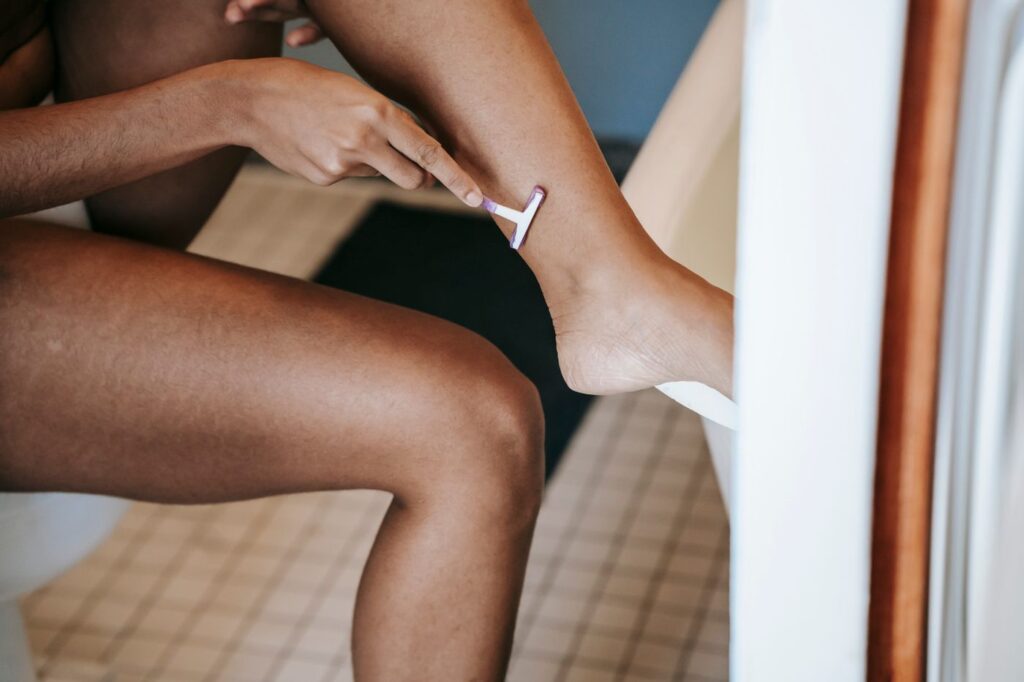
Shaving is the single biggest contributor, and the reason is simple geometry. A blade cuts the hair off at or just below the skin surface, leaving a sharp, angled tip. That tip is effectively a needle pointed at the follicle wall.
Shaving against the grain, stretching the skin taut to get closer, or going over the same patch repeatedly all make this worse by cutting the hair below the surface, where it has to travel further — and has more chance to go astray — before it emerges. The American Academy of Dermatology makes the same point in its razor bump guidance: shaving in the direction of growth is one of the highest-impact changes you can make.
Waxing, Epilating and Plucking
Removing hair from the root avoids the sharp-tip problem but introduces a different one. Yanking a hair out can distort the follicle, and when the new hair grows into a bent or scarred follicle it is more likely to become trapped.
Waxing also breaks some hairs partway rather than removing them cleanly, leaving a fragment beneath the surface that never finds its way out.
Dead Skin Build-Up
Every follicle opening can be blocked by the natural build-up of dead skin cells. When that happens, the emerging hair meets a lid it cannot push through and grows sideways instead. This is why ingrown hairs cluster in areas that are shaved often but exfoliated rarely.
Friction and Clothing
Tight underwear, synthetic fabrics, gym leggings and long periods of sitting all press regrowing hair flat against the skin and irritate the follicle opening. Shaving immediately before a long day in tight clothing — or before a workout — is a reliable way to produce bumps.
Hair Type and Genetics
Some of this is simply outside your control. The curlier and coarser your hair, the higher your baseline risk, regardless of technique. Research on pseudofolliculitis consistently finds that people with tightly coiled hair are significantly more prone to ingrown hairs and to the dark marks that can follow them. If that is you, prevention matters far more than treatment — and reducing how much hair grows back at all matters most of all.
How to Get Rid of an Ingrown Pubic Hair You Already Have
Step 1: Stop Removing Hair in That Area
This is the step everyone skips and the one that does the most work. Shaving over an inflamed follicle re-opens it, introduces bacteria, and restarts the cycle. Leave the area alone until the bump has fully settled — usually a few days to two weeks.
Step 2: Apply a Warm Compress
Hold a clean flannel soaked in warm (not hot) water against the bump for five to ten minutes, two or three times a day. Warmth softens the skin over the follicle, encourages the trapped hair towards the surface, and increases local blood flow so the inflammation resolves faster.
A large proportion of ingrown hairs will release themselves within a few days of consistent warm compresses and nothing else.
Step 3: Use Gentle Chemical Exfoliation — Not a Scrub
Physical scrubs on an inflamed follicle add trauma to trauma. A mild chemical exfoliant works better: salicylic acid (a BHA) dissolves the oil and dead skin plugging the follicle, while glycolic or lactic acid loosens the surface layer so the hair can break through.
Apply to the bikini line and outer pubic area only. Never apply acids to mucous membranes or internal genital skin. Patch test first, and stop if you experience burning rather than mild tingling.
Step 4: Do Not Dig It Out
Tweezing, squeezing, and needle-picking are how a minor bump becomes a scar, a dark mark, or an infection. Breaking the skin gives bacteria a direct route into an already inflamed follicle. NHS guidance on ingrown hairs is blunt about this: do not pick or scratch them.
There is one narrow exception: if the hair has clearly broken through the surface and a visible loop is sitting on top of the skin, you may gently lift it free with sterilised tweezers. Do not pull the hair out, and do not go hunting under the skin for it.
Step 5: Keep It Clean and Reduce Friction
Wash with a mild, fragrance-free cleanser and pat dry rather than rubbing. Wear loose cotton underwear while the bump heals. Skip the gym leggings, the swimming pool and the hot tub until the skin is intact again.
When to See a Doctor
Most ingrown hairs resolve on their own. Book an appointment if you notice spreading redness, increasing pain, significant pus, a bump that keeps enlarging, a fever, or ingrown hairs that recur constantly despite good technique. A clinician can safely release a deeply trapped hair, prescribe a topical or oral antibiotic if the follicle is infected, and rule out conditions that mimic ingrown hairs.
How to Prevent Ingrown Pubic Hair
If You Shave, Shave Correctly
- Shave at the end of a warm shower, once the hair has softened for several minutes.
- Always use a lubricating gel or cream — never a dry razor, and never plain soap.
- Shave with the direction of growth, not against it. You will get a slightly less close result and dramatically fewer bumps.
- Use light, short strokes and do not stretch the skin tight.
- Rinse the blade after every stroke and replace it every five to seven shaves. A dull blade tugs and cuts unevenly.
- Never go over the same area repeatedly chasing smoothness.
Exfoliate on a Schedule
Exfoliating the bikini area two to three times a week keeps follicle openings clear so regrowth can emerge properly. Do it on non-shaving days, not immediately before or after hair removal, and favour a gentle chemical exfoliant over an abrasive scrub.
Moisturise and Let the Skin Breathe
Hydrated skin is more pliable and easier for a hair to push through. Use a light, fragrance-free moisturiser on the bikini line after hair removal. Choose cotton underwear over synthetics, and avoid tight waistbands for the first day or two after shaving.
Extend the Gap Between Sessions
Every hair removal session is another chance for a follicle to go wrong. Shaving daily is close to guaranteeing bumps. The fewer times you have to touch the area, the fewer ingrown hairs you will get — which points directly at the real solution.
The Permanent Fix: Stop the Regrowth Cycle Entirely
Why Fewer Hairs Means Fewer Ingrowns
Everything above manages the symptom. An ingrown hair requires two ingredients: a hair, and a reason for it to grow back badly. Better shaving technique addresses the second. Reducing how much hair grows back in the first place addresses both.
This is why IPL is so effective for people who suffer from chronic ingrown hairs in the bikini area. IPL targets melanin in the hair and follicle, converting light into heat that disrupts the follicle’s ability to produce new hair. Over a course of sessions, the hair that does return comes back finer, sparser and softer — and a fine, soft hair simply does not have the structural stiffness to pierce the follicle wall the way a coarse, blade-cut one does.
The second benefit is indirect but just as important: as the treatment course progresses, you stop needing to shave every few days. Fewer blades, fewer sharp tips, less irritation, fewer bumps. If you want the full picture on how long results hold, we covered it in detail in Is IPL Hair Removal Permanent? How Long Results Actually Last.
What to Expect on the Bikini Line
Most people run an initial course of 8–12 weekly sessions, with the first visible thinning after two or three. The bikini area is hormonally influenced, so it typically holds results slightly less indefinitely than legs or underarms and benefits from occasional maintenance top-ups.
A few practical notes for this area specifically: shave (do not wax or epilate) the day before a session, since IPL needs the follicle intact below the surface and the hair short above it. Treat the outer bikini line and pubic mound only — IPL is not for internal or mucosal areas. And do not run a session over skin that currently has an active, inflamed ingrown hair; let it settle first.
IPL works best where there is good contrast between darker hair and lighter to medium skin tone (Fitzpatrick I–V). It is less effective on blonde, red, grey or white hair, which lacks the melanin the light needs to target.
Tired of managing bumps week after week? The SnowySkin™ IPL Laser Hair Removal Handset is FDA-cleared, completely painless, and backed by a 90-day money-back guarantee — so you can treat the bikini line at home, on your own schedule, and stop the ingrown hair cycle at its source.
Frequently Asked Questions About Ingrown Pubic Hair
How long does an ingrown pubic hair take to go away?
Most ingrown pubic hairs resolve on their own within one to two weeks, provided you stop shaving the area and avoid picking at it. Warm compresses two to three times a day usually speed this up considerably. If a bump has not improved after two weeks, is getting larger, or is increasingly painful, see a doctor.
Should I pull out an ingrown pubic hair with tweezers?
No — not if it means digging beneath the skin. Picking or tweezing an embedded hair breaks the skin barrier and is the most common cause of infection, scarring and dark marks in this area. The only safe exception is gently lifting a loop of hair that has already broken through to the surface, using sterilised tweezers, without pulling the hair out.
Why do I get so many ingrown hairs on my bikini line specifically?
The pubic area combines every risk factor at once: coarse, tightly curled hair that naturally curves back towards the skin, a high density of follicles, constant friction from underwear and clothing, a warm and moist environment, and more frequent shaving than most other body areas receive. It is not a technique failure — it is the hardest area on the body to keep bump-free.
Is it an ingrown hair or something else?
A typical ingrown hair is a single tender bump appearing two to five days after hair removal, often with a visible hair curled beneath the surface. Many small pustules across a wide area is more likely folliculitis. A firm, deeper lump unrelated to a shaving session may be a cyst. Anything that does not resolve within two weeks, keeps returning in the same spot, or is accompanied by fever should be assessed by a clinician rather than self-treated.
Does waxing cause fewer ingrown hairs than shaving?
Sometimes, but not reliably. Waxing avoids the sharp angled tip that shaving creates, and the longer regrowth interval helps. However, waxing can distort the follicle and frequently breaks hairs partway rather than removing them cleanly, both of which cause their own ingrown hairs. Many people find they simply trade one pattern of bumps for another.
Can IPL help with ingrown pubic hair?
Yes, and it addresses the root cause rather than the symptom. IPL progressively reduces the number of hairs that regrow and makes the remaining hair finer and softer, so it is far less able to pierce the follicle wall. It also means you shave far less often, removing the main trigger entirely. For people with chronically recurring ingrown hairs, this is usually the most effective long-term solution.
Can I use IPL if I currently have an ingrown hair?
Wait until it has settled. Do not treat over skin that is actively inflamed, broken, or infected. Once the bump has resolved and the skin is intact, shave the area the day before and resume your normal session schedule.
How do I stop ingrown pubic hair from coming back?
Shave with the grain using a sharp blade and plenty of lubricant, exfoliate the bikini line gently two to three times a week on non-shaving days, moisturise afterwards, wear loose cotton underwear, and — most importantly — increase the gap between hair removal sessions. Reducing regrowth with IPL is the most durable way to achieve that last point.
Do ingrown hairs leave dark marks or scars?
They can, particularly if picked. Post-inflammatory hyperpigmentation — a flat dark mark left after the inflammation resolves — is common, especially on medium to deeper skin tones, and can take months to fade. Not picking is the single most effective way to avoid both marks and scarring.
Sources and Further Reading
- American Academy of Dermatology — Razor bump prevention tips from dermatologists
- NHS — Ingrown hairs: symptoms, treatment and prevention
- Ribera M. et al. — Pseudofolliculitis barbae: a dermatoscopic correlate (PMC, National Library of Medicine)
- SnowySkin — Is IPL Hair Removal Permanent? How Long Results Actually Last
