
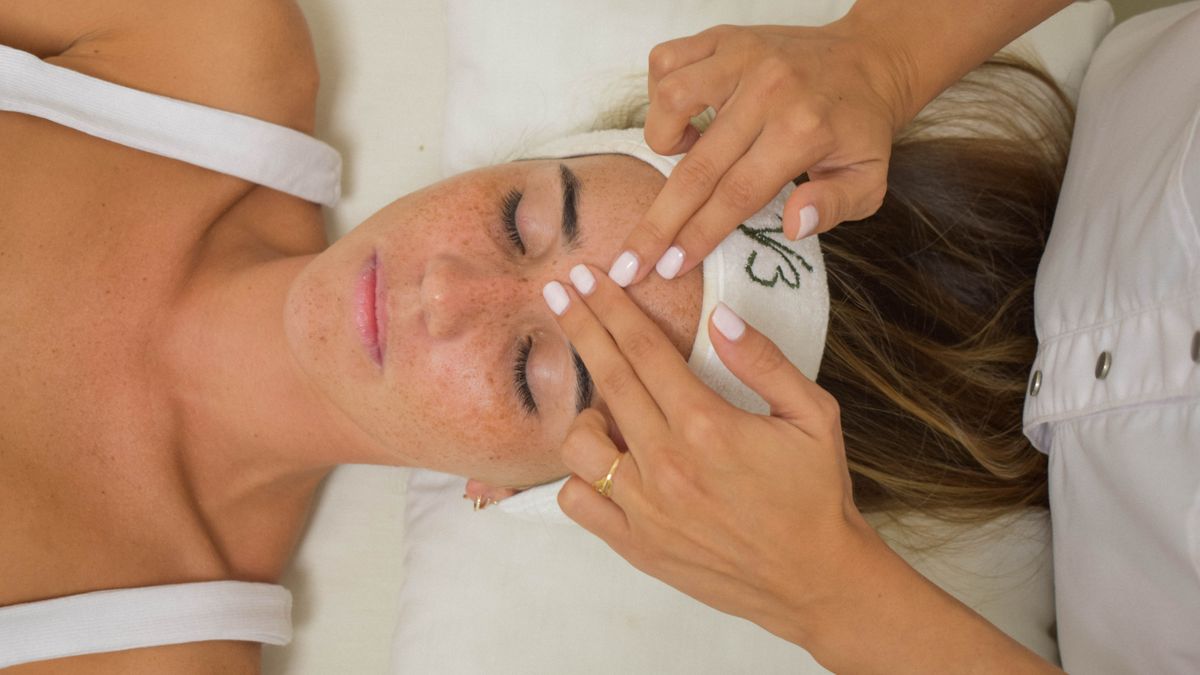
Facial massage for wrinkles is having a moment. Gua sha stones, jade rollers, lymphatic drainage tutorials, five-minute “face lift” routines — all of it promising smoother, firmer, less lined skin for the price of a few minutes a day.
So does facial massage for wrinkles actually work? The honest answer is: partly, modestly, and not in the way most of the internet claims. There is real science behind some of it, and real overstatement around the rest.
This guide separates the two — what the research on facial massage for wrinkles genuinely supports, what facial massage does well, what it cannot do at all, and how to do it properly so you get the benefits without stretching or irritating your skin in the process.
Key Takeaways
- Facial massage for wrinkles will not erase established lines. Nothing topical or manual will — that is the honest starting point.
- It does have measurable effects: laboratory work shows mechanical stimulation increases expression of dermal proteins including procollagen-1, tropoelastin and fibrillin.
- Its most reliable real-world benefits are reduced puffiness, better product absorption, released muscle tension, and improved circulation and glow.
- Massage works best as an amplifier — clinical evidence is strongest when a massage device is combined with an anti-ageing cream rather than used alone.
- Technique matters more than tools. Always use slip, work upwards and outwards, and never drag dry skin.
- Daily sunscreen and a retinoid still outperform every massage routine ever written for actual wrinkle prevention.
Does Facial Massage for Wrinkles Actually Work?
What the Research on Facial Massage for Wrinkles Shows
There is more evidence for facial massage for wrinkles than sceptics assume, and far less than marketing implies.
The most cited work is a study on a skin-massaging device and dermal protein expression. Working on ex vivo human skin, researchers found that mechanical massage increased the expression of decorin, fibrillin, tropoelastin and procollagen-1 — the structural proteins that give skin its firmness and elasticity. The effect was frequency-dependent, peaking around 75Hz.
The same paper included a small clinical arm: twenty women aged 65–75 used an anti-ageing cream, half of them adding daily massage-device treatment for eight weeks. The group combining massage with the cream saw greater improvement than the cream alone.
That is genuinely interesting — but note the caveats. It is a small sample, it used a specific powered device rather than fingers or a stone, and the benefit appeared as an amplification of a skincare product rather than a standalone result.
Facial exercise has been studied separately, and there a systematic review of facial exercises for facial rejuvenation concluded the evidence remains limited and inconsistent, with most studies small or poorly controlled. Facial exercise and facial massage are not the same thing, and neither has the evidence base that sunscreen or retinoids do.
What Facial Massage for Wrinkles Genuinely Does Well
- Reduces puffiness. Gentle lymphatic-style strokes move interstitial fluid towards drainage points. This is the fastest, most visible effect — often within minutes, particularly around the eyes and jawline in the morning.
- Improves product absorption. Massaging a serum or oil in, rather than patting it on, increases contact time and spread. If massage amplifies your actives, that is a real benefit.
- Releases muscle tension. Clenched jaw, furrowed brow and squinting all hold tension in facial muscles. Releasing it can visibly soften expression lines temporarily.
- Boosts circulation. The flush after a massage is increased blood flow, which is why skin looks brighter and more “awake” immediately afterwards.
- Feels good. Not a trivial point. A routine you enjoy is a routine you keep, and consistency is what makes any skincare work.
What It Cannot Do
Facial massage cannot remove deep static wrinkles — the lines visible when your face is completely at rest. Those reflect structural change in the dermis and volume loss underneath, and no amount of manual stimulation reverses that.
It cannot lift sagging caused by loss of bone density, fat pad descent or collagen decline. It does not “sculpt” bone or permanently change facial contour, whatever a before-and-after video suggests — most of that difference is de-puffing, lighting and angle.
| Claim | Verdict | Reality |
|---|---|---|
| Reduces morning puffiness | Supported | Visible within minutes; the most reliable benefit |
| Improves absorption of actives | Supported | Mechanically sensible and clinically suggested |
| Stimulates dermal proteins | Promising | Shown in lab tissue; small human trial, device-specific |
| Softens expression lines | Partly | Via tension release; temporary, not structural |
| Erases deep static wrinkles | No | Requires retinoids, resurfacing or in-clinic treatment |
| Permanently lifts or sculpts the face | No | Cannot change bone, fat pads or collagen loss |
How to Do a Facial Massage for Wrinkles
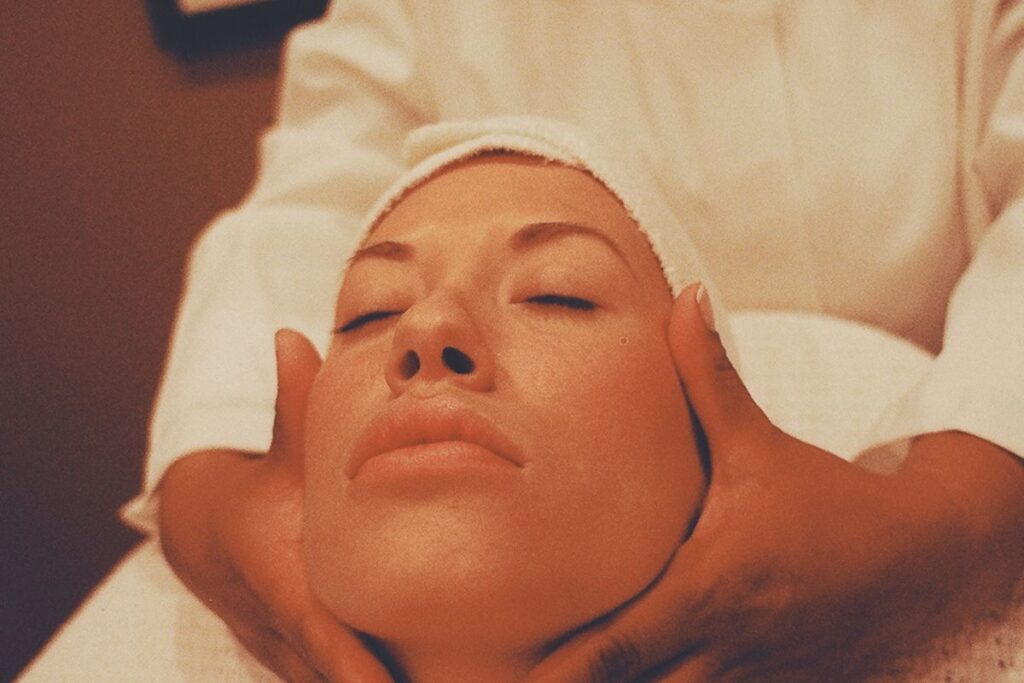
First: Always Use Slip
This is the single most important rule in facial massage for wrinkles, and the one most often broken. Never massage or drag a tool across dry skin. Friction on unlubricated skin tugs at the very tissue you are trying to protect and can cause irritation and broken capillaries.
Apply a facial oil, balm, or a rich serum with enough slip that your fingers glide rather than pull. You should be able to move across the skin without the surface moving much with you.
A Five-Minute Facial Massage for Wrinkles Routine
- Neck first (30 seconds). Long, light downward strokes from under the jaw to the collarbone. This opens the drainage route — doing the face first sends fluid nowhere.
- Jawline (1 minute). From the centre of the chin, glide along the jaw towards the ear, then down the neck. Repeat 5–10 times each side.
- Cheeks (1 minute). From the side of the nose, sweep outwards and slightly upwards towards the temple, then down towards the ear. Light pressure only.
- Under-eyes (30 seconds). The most delicate area. Use your ring finger, almost no pressure, and sweep from the inner corner outwards along the orbital bone — not on the lid itself.
- Brow and forehead (1 minute). Press and release along the brow bone to relieve tension, then sweep from the centre of the forehead outwards towards the temples.
- Finish at the neck (30 seconds). Repeat the downward neck strokes to clear everything you have just moved.
Pressure should be light — lymphatic vessels sit just beneath the skin, and pressing hard bypasses them entirely while risking tissue stretch. If your skin is visibly moving and creasing under your fingers, you are pushing too hard.
How Often Should You Do Facial Massage for Wrinkles?
Daily is fine if pressure is light and you always use slip. Five minutes is plenty; longer sessions do not scale the benefit. Morning suits de-puffing, evening suits tension release and product absorption.
Expect the puffiness benefit immediately, a general improvement in tone and glow within two to three weeks, and — realistically — subtle changes at best beyond that. Judge it at eight weeks, which is the timeframe the clinical work used.
Tools: Gua Sha, Rollers and Devices
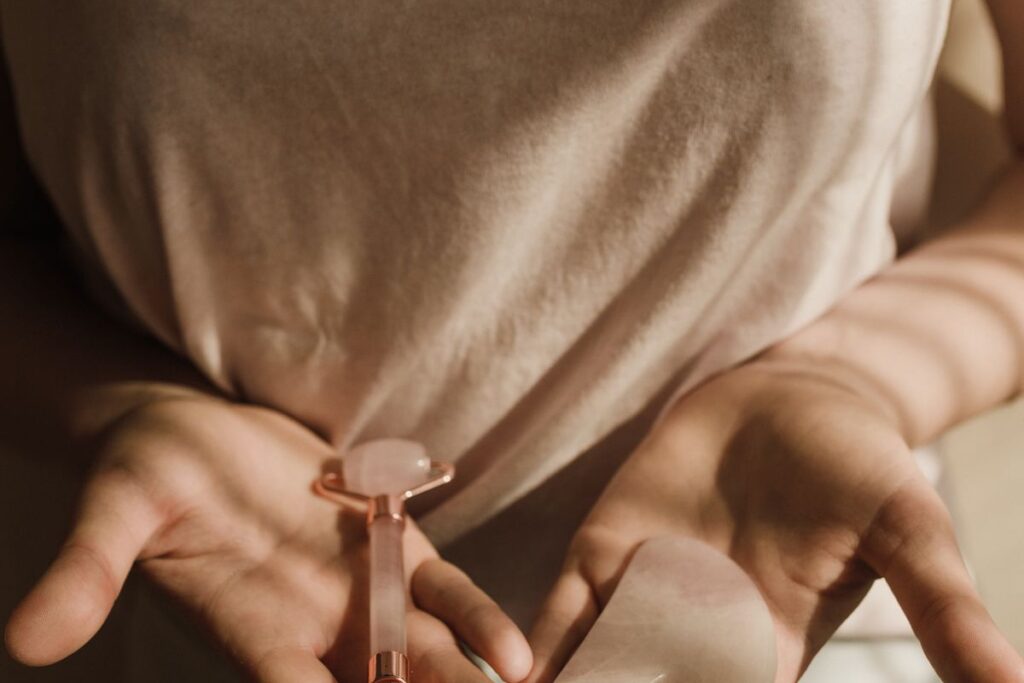
Gua Sha Stones
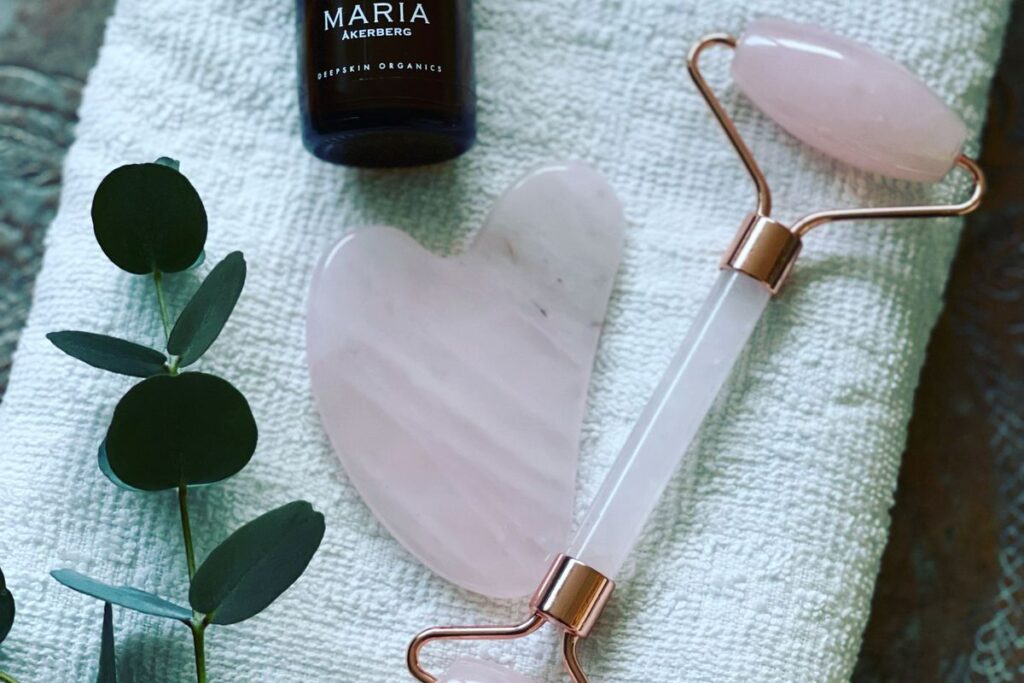
A flat stone with contoured edges, held nearly flat against the skin and drawn along the jaw, cheekbone and brow. The broad contact makes it good for tension release and drainage. Traditional gua sha on the body uses firm pressure to deliberately raise petechiae — facial gua sha does not, and should never bruise. If you are seeing redness that lasts, you are pressing far too hard.
Jade and Quartz Rollers
Easier to use and harder to get wrong than gua sha, but with less targeted effect. Their main advantages are the cooling sensation — genuinely useful for morning puffiness, especially if kept in the fridge — and how pleasant they are to use, which aids consistency. Do not expect a roller to do anything structural.
Powered Massage Devices
Worth noting that the strongest published evidence involved a powered, frequency-specific device rather than a stone or fingers. If you want to follow the research most closely, that is the category it points to — though results in that trial still came alongside an anti-ageing cream, not instead of one.
Do You Actually Need a Tool?
No. For facial massage for wrinkles, clean hands do the same job, with better pressure feedback and no risk of dragging. Tools add glide, cooling and a sense of ritual. Buy one if it makes you more likely to do the routine — that is a legitimate reason — but not because a stone can do something fingers cannot.
Facial Massage for Wrinkles: Mistakes That Make Them Worse
- Massaging dry skin. The fastest way to turn a beneficial routine into a damaging one.
- Using heavy pressure. Repeatedly stretching skin does not tighten it. Aggressive downward dragging is particularly counterproductive.
- Working the under-eye too vigorously. The thinnest skin on the face deserves the lightest touch you can manage.
- Massaging over active breakouts, eczema, rosacea flares or broken skin. You will spread bacteria and worsen inflammation. Wait until it settles.
- Doing it straight after strong actives or a peel. Skin is already sensitised; add friction and you get irritation.
- Using a dirty tool. Stones and rollers collect oil and bacteria. Wash after every use.
What Actually Works Best for Wrinkles
If wrinkle reduction is the actual goal, facial massage for wrinkles belongs somewhere near the bottom of a priority list that looks roughly like this:
- Daily broad-spectrum SPF 30+. UV exposure is the dominant driver of premature skin ageing. Nothing else you do matters as much, and the American Academy of Dermatology puts it first for the same reason.
- A retinoid. The best-evidenced topical for stimulating collagen. Introduce slowly and expect to wait — the AAD notes most anti-ageing products take six weeks to three months to show results.
- Consistent moisturising. Will not remove wrinkles but visibly softens fine lines by hydrating the surface.
- Not smoking, and sleeping properly. Both have well-documented effects on skin ageing.
- In-clinic treatments. For established wrinkles, resurfacing, injectables and energy-based devices are what actually shift them.
- Facial massage for wrinkles. A genuine but supporting player — best for puffiness, tension and helping the steps above work harder.
If deep lines are your main concern, facial massage for wrinkles will only take you so far — a consultation with a dermatologist will get you further than any at-home routine. Massage is a good habit, not a substitute for treatment.
Fitting Facial Massage Around Facial Hair Removal
If your facial routine also includes hair removal on the upper lip, chin or jawline, sequencing matters — both processes involve the same delicate skin.
- Do not massage immediately after waxing, threading or an IPL session. Skin is already sensitised and slightly inflamed; give it 24–48 hours.
- Avoid heavy facial oils in the hours before an IPL session — the surface should be clean, dry and free of product.
- Never work a gua sha stone over skin that is currently irritated, broken or showing ingrown hairs.
Beyond that they sit together comfortably: massage on non-treatment days, hair removal on its own schedule. If you are considering at-home facial hair removal, the SnowySkin™ IPL Laser Hair Removal Handset is FDA-cleared and safe for use on the upper lip, chin and jawline, keeping the device below the cheekbones and away from the eyes.
Frequently Asked Questions About Facial Massage for Wrinkles
Does facial massage for wrinkles really work?
Facial massage for wrinkles does not work on its own, and not on deep static lines. Facial massage reliably reduces puffiness, releases muscle tension and improves circulation and product absorption, and laboratory research shows mechanical stimulation increases dermal proteins like procollagen-1 and tropoelastin. But the clinical evidence for wrinkle improvement is small-scale and strongest when massage is combined with an anti-ageing cream rather than used alone.
How often should I do facial massage for wrinkles?
Daily is safe provided you use light pressure and always apply oil or a slip-heavy serum first. Five minutes is enough, and longer sessions do not produce proportionally better results. Many people prefer mornings for de-puffing and evenings for tension release and better absorption of night-time skincare.
Can facial massage for wrinkles actually make them worse?
It can if done badly. Massaging dry skin, using heavy pressure, dragging downwards or working aggressively around the eyes all stretch and stress the tissue you are trying to protect. Done gently over adequate slip, facial massage is not a wrinkle risk — the damage comes from friction and force, not from the massage itself.
Is gua sha better than a jade roller for wrinkles?
Gua sha offers more targeted work along the jaw, cheekbone and brow, and is generally better for releasing tension and encouraging drainage. Rollers are gentler, easier to use correctly, and better for cooling and morning puffiness. Neither has been shown to change wrinkles structurally, so choose whichever you will actually use consistently.
How long does it take to see results from facial massage for wrinkles?
Reduced puffiness is immediate, often within a single session. Improved tone, glow and softened tension typically show within two to three weeks of consistent daily practice. For anything beyond that, judge at around eight weeks — the duration used in the clinical research — and set expectations towards subtle rather than dramatic.
Should I use oil for facial massage?
Yes — oil, balm or a serum with real slip is essential. Massaging dry skin creates friction that tugs at the tissue and can cause irritation and broken capillaries. If you are acne-prone, choose a non-comedogenic oil or a slip-heavy gel serum instead of a heavy facial oil.
Can facial massage replace retinol or sunscreen?
No. Daily broad-spectrum sunscreen and a retinoid are by a wide margin the best-evidenced at-home steps for preventing and improving wrinkles. Facial massage is a complement to those, and the research suggests it works best precisely when paired with an active skincare product rather than used in place of one.
Who should avoid facial massage?
Skip it over active acne, eczema or rosacea flares, sunburn, broken skin or recent cosmetic procedures. If you have had injectables, ask your practitioner how long to wait. Anyone with a skin condition affecting the face should check with a dermatologist before adding regular massage.
Do facial exercises work the same way as facial massage?
They are different things. Facial massage applies external pressure to skin and underlying tissue; facial exercise deliberately contracts the facial muscles. A systematic review of facial exercises for rejuvenation found the evidence limited and inconsistent, and repeatedly contracting muscles is also how dynamic expression lines form in the first place — so approach exercise programmes with more caution than massage.
Sources and Further Reading
- Crémoúx et al. — Effects of a skin-massaging device on the ex-vivo expression of human dermis proteins and in-vivo facial wrinkles (PMC, National Library of Medicine)
- Van Borsel et al. — The effectiveness of facial exercises for facial rejuvenation: a systematic review (PubMed)
- American Academy of Dermatology — Wrinkle remedies and 11 ways to reduce premature skin ageing
- SnowySkin — Is IPL Hair Removal Permanent? How Long Results Actually Last
